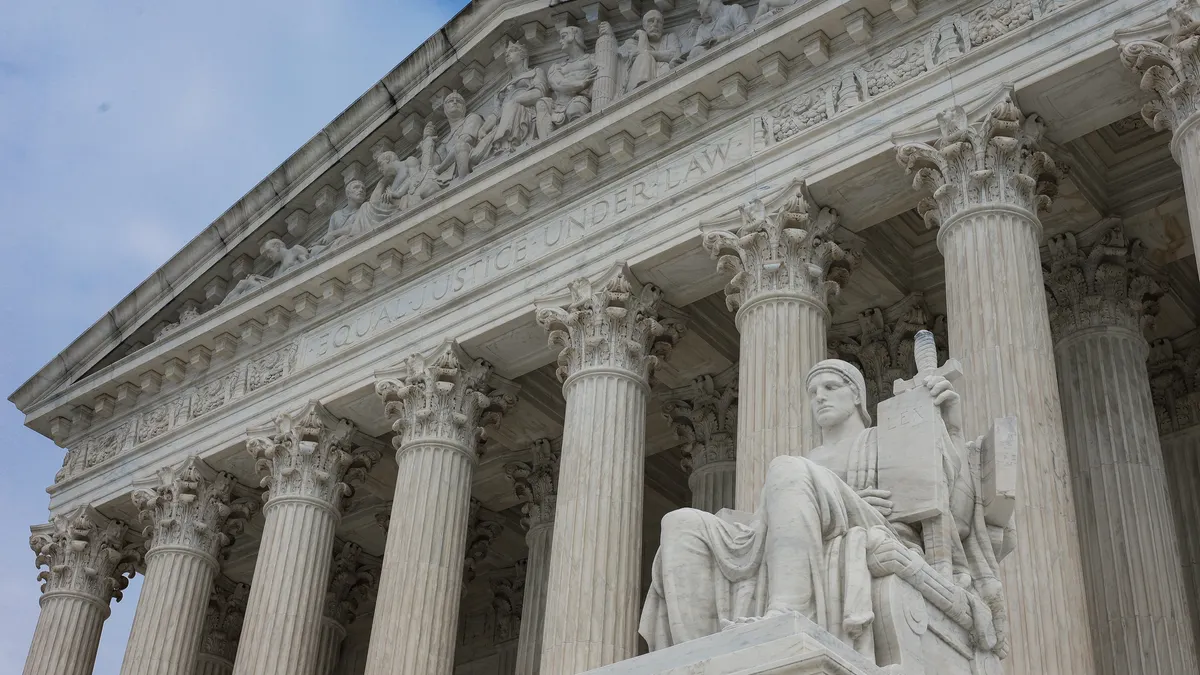
A monumental Supreme Court opinion released Thursday sided with a trucking crash victim’s case, aiding states’ abilities to regulate the brokerage industry in safety matters.
The Supreme Court opinion brings clarity to the judicial system, determining a safety provision empowering states means brokers are not immune from negligent hiring claims. Federal courts have handled the issue differently, and the opinion brings new oversight and less protection to brokers.
"Brokers can now be sued in state court for negligently selecting unsafe carriers," law firm Husch Blackwell Partner Julie Maurer said in a statement to Trucking Dive. "The decision does not, however, mean automatic liability. Brokers who conduct reasonable due diligence in carrier selection should be well-positioned to defend against such claims.”
While federal law from the ’90s gives the brokerage industry some protection under a preemption provision, a safety exception can and does apply in this case, the Supreme Court found.
Now that the lower courts’ decisions have been reversed, the case will head back to a U.S. appeals court for further proceedings.
Industry advocates previously warned such an outcome could significantly shift the industry landscape of who is selected for transporting freight.
"In the short term, there will be uncertainty as to how claims of negligent brokerage will play out in practice," Duane Morris Partner Harry Byrne said in a statement to Trucking Dive. "Shippers and brokers may opt for the large, reputable trucking companies, to guard against these claims. For motor carriers, they should expect a greater focus on their safety ratings and compliance history."
Truck driver Shawn Montgomery, who had his leg amputated from the crash that initiated the case, alleged C.H. Robinson Worldwide failed to exercise reasonable care when it hired Caribe Transport, which had a subpar safety rating, for a shipment, the opinion noted.
Dorothy Capers, chief legal officer at C.H. Robinson, said in a statement that safety is foundational to the company and the business will “continue to operate responsibly, support stronger federal enforcement, and work constructively with regulators, carriers, and customers to strengthen the national safety system and support safe, reliable transportation across the country.”
A concurring opinion by Justice Brett Kavanaugh, joined by Justice Samuel Alito, wrote that the court’s decision should “not be read to mean that brokers will routinely be subject to state tort liability in the wake of truck accidents” and brokers can still successfully defend themselves against state tort lawsuits when they acted responsibly.
Maurer of Husch Blackwell pointed to Kavanaugh's concurring opinion, adding that "a plaintiff must still demonstrate that the broker’s failure to select a safe carrier caused the accident—a meaningful hurdle that should temper concerns about open-ended exposure."
But as industry groups and key transportation intermediaries warned, the court’s action could have impacts on insurance, risk and costs, the concurring opinion noted. Kavanaugh suggested that the result will mean American consumers will help bear the costs with higher prices.
The Transportation Intermediaries Association quickly expressed its dissapointment in the outcome. President and CEO Chris Burroughs said in a statement, “While brokers are fully committed to safety and to working with federally licensed motor carriers in good standing, the decision imposes an impossible task on brokers” that entails evaluating safety of a motor carrier despite the federal government deeming a carrier as safe to operate.
“This is like asking travel agents to evaluate the safety of a given airline despite the fact that the airline has been licensed to fly by the federal government,” Burroughs said.
Editor's note: This story was updated with additional legal commentary from law firm Husch Blackwell.