Dive Brief:
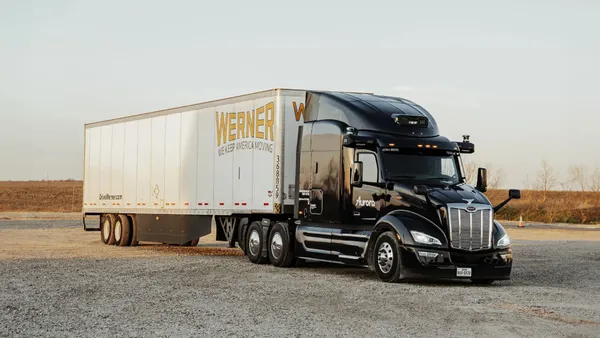
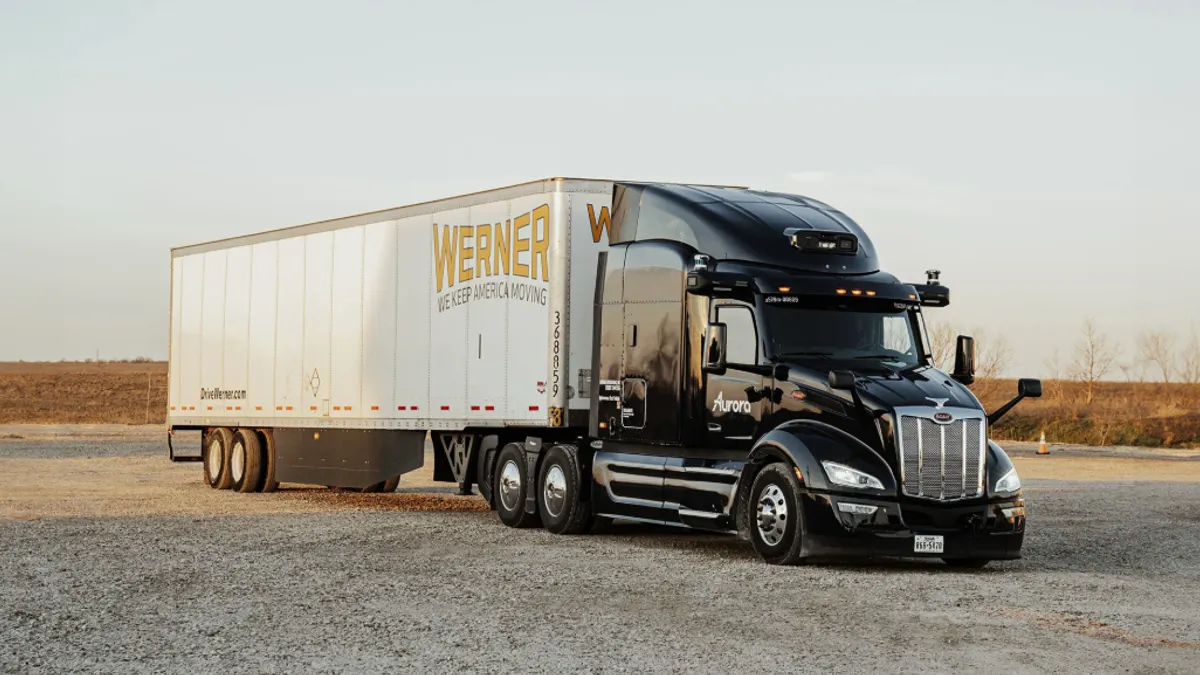
- Werner Enterprises is working with several autonomous trucking developers and brokering freight to them, CFO Christopher Wikoff said at Morgan Stanley’s Laguna Conference Sept. 15.
- In most cases, those runs operate with a safety driver behind the wheel and an engineer in the jump seat to collect data. Werner’s long-term goal is fully driverless operations, with no one in the cab.
- “It’s something we’re excited about,” Wikoff said. “The technology is the real deal. If anyone wants to say, ‘I can’t believe that a truck can actually do all the things that these companies say,’ the truck can do it. We’re 100% bought in on that.”
Dive Insight:
Werner has long positioned itself as an early adopter of autonomous technology. The Omaha, Nebraska-based carrier made an equity investment in TuSimple, and in 2022 began a pilot with Aurora Innovation, hauling loads between Forth Worth and El Paso. It also began working with Kodiak AI in 2022 to create an autonomous trucking lane.
Since then, the industry has moved beyond small pilots. Aurora has expanded its driverless network in Texas, adding an overnight run and, earlier this year, routes to Phoenix. Wikoff’s comment, however, made clear that confidence in the technology doesn’t yet translate into confidence in the business case. Werner remains uncertain about how soon, and at what scale autonomous trucks can be deployed in its operations.
Wikoff pointed to two unresolved issues, in Werner’s view:
- Economics: “We believe that the economics are not favorable to autonomous right now,” Wikoff said, though he did not elaborate. The model Werner described points to part of the challenge: as long as runs require a safety driver and an onboard engineer, carriers are paying for expensive autonomy hardware and software without capturing the labor savings that drive much of the investment case.
- Insurance and claims: Liability is the larger open question. “If the software fails and causes an accident, the autonomous companies across the board have said ‘We’ll take care of that.’ If Werner or the carrier did something to cause the accident, of course that’s our problem,” Wikoff said. “There’s a lot of gray between those two that we have to figure out before anybody would go to scale, or at least any publicly traded company.”
Once those questions are resolved, Werner sees autonomous as a way to add capacity rather than replace its workforce, Wikoff said.
“We’ve been loud with our driver fleet,” he said. “Even if the bull case of autonomous takes flight, we will need more drivers next year and 10 years from now than we have now.”