Dive Brief:
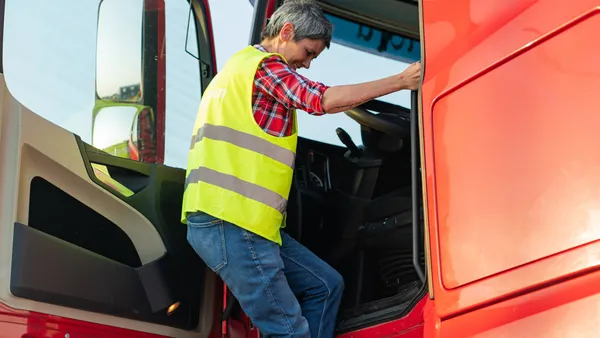
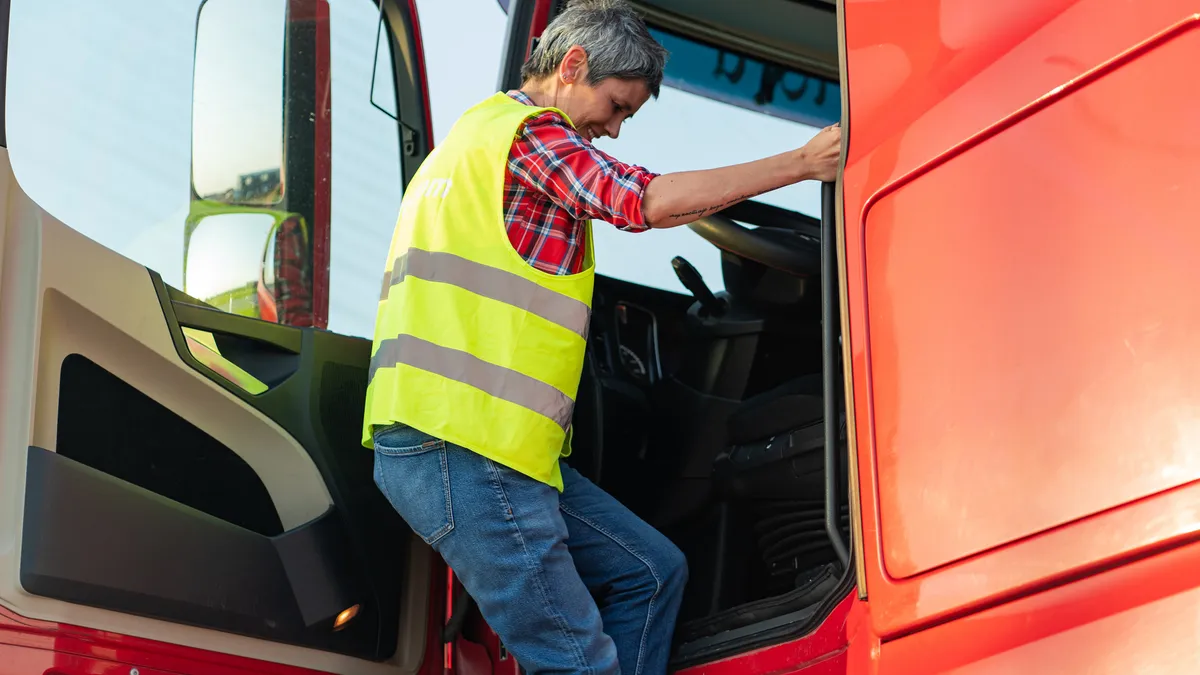
- Women’s share of the trucking workforce has held largely flat, according to the Women In Trucking Association’s WIT Index released Aug. 27, with nearly one in 10 serving in professional driving roles.
- About 210 companies submitted gender diversity data for the index, more than half of which were for-hire motor carriers or companies with private fleets.
- Leadership was a bright spot, as the index found that 31% of women hold C-suite and executive positions, 37.5% of supervisory positions and 29% of board seats, WIT leaders said during an Aug. 26 livestream.
Dive Insight:
The smallest carriers have the deepest bench of women drivers. Micro and small businesses reported that women make up 12.5% of their CDL holders, according to the WIT livestream presentation.
That compares with 10.5% of women holding such roles at medium and large enterprises and 7% at companies with more than 5,000 employees. Meanwhile, women account for just 2.5% of diesel technicians and mechanics.
“We certainly have seen some uptick and some progress with women who are behind the wheel and professional truck drivers, and I think it’s because we as an industry are really trying to make that career path something that women can envision themselves in and it’s easy for them to see that,” commented Brian Everett, strategy and management for Women In Trucking, during the livestream. “Technicians and mechanics, I just don’t think we’ve made as much progress and we haven’t necessarily put as much intention as an industry behind that.”
The index found that women have the highest foothold in office and support functions: 76.5% in human resources and talent management roles, 45.5% in dispatcher jobs, and 44% in safety positions. Dispatch, in particular, rewards skills women bring to the job, said Jenny Fall, director of driver engagement at Women In Trucking.
“The empathy, the customer service — those soft skills that really help women succeed in different roles,” she said. “Dispatchers are the voice to the truck driver, and if they aren’t calm, if they’re not respectful and if they’re not on their game, drivers might not be as safe. They might not stay at the company as long.”
Later on in the livestream, Everett pointed to smaller, family-owned operations as the likeliest source of near-term gains in leadership.
“I think as we get past some of the social changes that are going on and perceptions of women in the workforce and the business world, that can have a big impact as well,” Everett said. “I think that there is a very direct correlation between some of those smaller companies that are family-owned, privately held, who suddenly they’re like ‘Hey men or women, it doesn’t matter.”