Dive Brief:
- The Federal Motor Carrier Safety Administration on Oct. 7 granted a five-year, limited exemption allowing Level 4 autonomous trucks to use cab-mounted warning beacons in place of the reflective triangles or flares a driver would normally set out around a stopped truck.
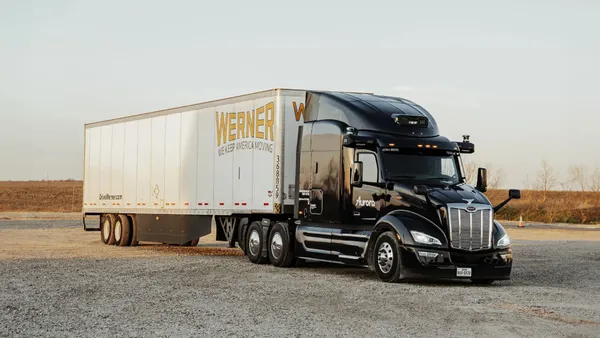
- The exemption covers federal requirements on the type and number of warning devices, where they must be placed and the use of steady-burning lamps. Aurora Innovation applied for the exemption in April, but other carriers operating Level 4 trucks can take advantage of it if they notify FMCSA before starting.
- Carriers must report crashes that occur while beacons are activated, or should have been, and file annual reports on beacon malfunctions, power failures and other performance problems. FMCSA reviewed 402 public comments before reaching its decision.
Dive Insight:
Without a human behind the wheel, warning other drivers about a stopped or broken-down truck has been a sticking point in commercializing autonomous fleets. The exemption to federal rules — which assume a driver will get out and place warning devices on the roadway — gives developers five years of regulatory certainty.
It also marks a reversal for the agency. FMCSA denied a joint Aurora and Waymo request for similar relief in 2024, saying the companies hadn’t shown the beacons would provide an equivalent level of safety. Aurora later sued the agency, securing a short-term waiver in October 2025.
This time, FMCSA concluded the beacons “would likely achieve a level of safety equivalent to, or greater than, the level of safety that would be achieved without exemption.”
“High-visibility, cab-mounted warning beacons are a critical, 21st-century solution that enhances roadside safety by immediately alerting other road users without ever needing to put a person in harm's way. This exemption is a meaningful step forward in making our roads safer for everyone,” Gerardo Interiano, SVP of government relations and public affairs at Aurora, said in an email to Trucking Dive.
Yet, the trucking industry as a whole remains divided.
The Autonomous Vehicle Industry Association and Volvo backed warning beacons for trucks with and without drivers, arguing they keep people off the roadways in dangerous conditions. The American Trucking Associations supported the exemption and urged FMCSA to study the resulting data for safety improvements that could apply to all commercial vehicles.
The Owner-Operator Independent Drivers Association opposed the application in formal comments, arguing the two studies submitted with Aurora’s application did not account for varying weather, road, lighting and traffic conditions that trucks encounter. In a statement, Todd Spencer, president and CEO of OOIDA, said the beacons fall short as a substitute for warning triangles across those conditions.
“This corporate carve-out sets a troubling precedent,” Spencer said in an emailed statement. “Relaxing safety standards for the AV industry, which fights tooth and nail against even minimal transparency and accountability, should alarm all highway users.”
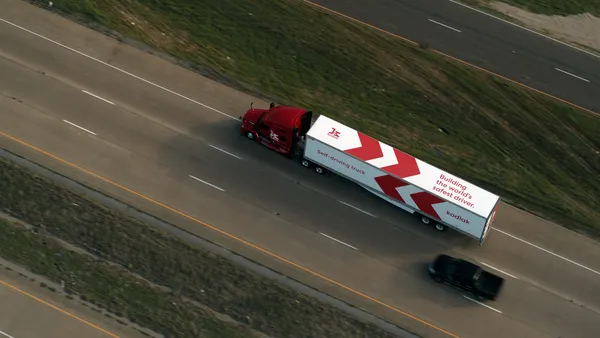
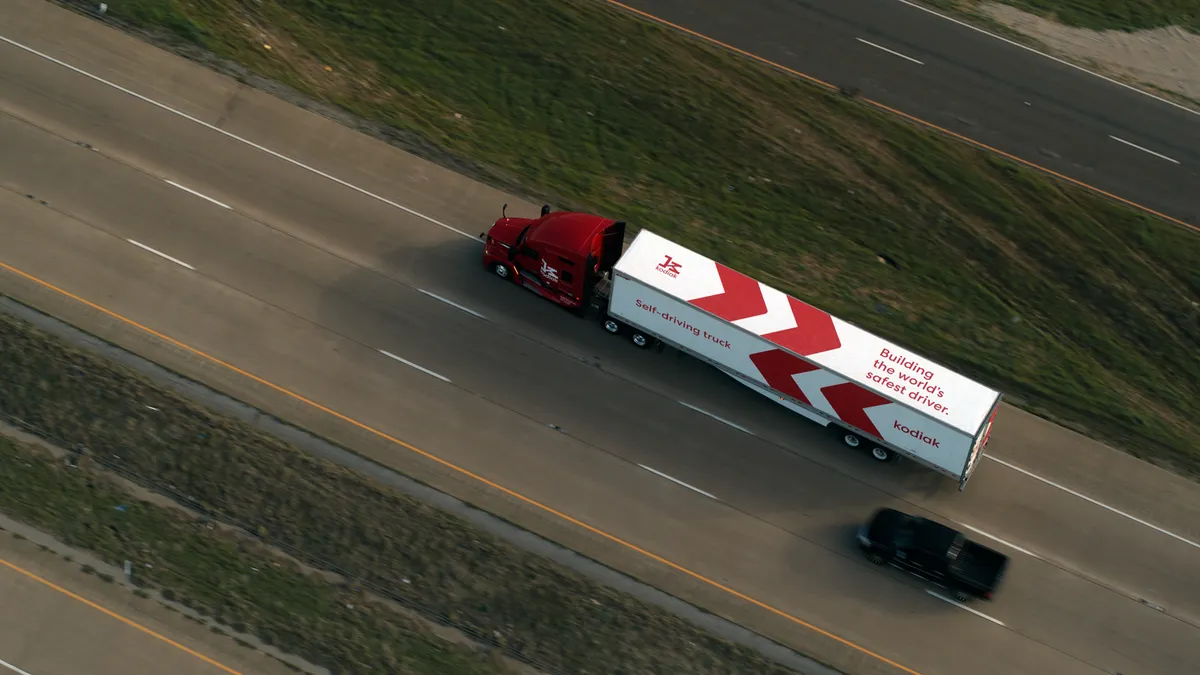
At least one other developer plans to use the exemption. Kodiak AI said via email that it will give FMCSA written notice of its intent to operate under its terms.
“This exemption further empowers Kodiak and other innovators to usher in an autonomous era of freight movement on U.S. roads, one that can save lives and improve the efficiency of goods delivery,” Daniel Goff, VP of external affairs at Kodiak, said in a statement.