Dive Brief:
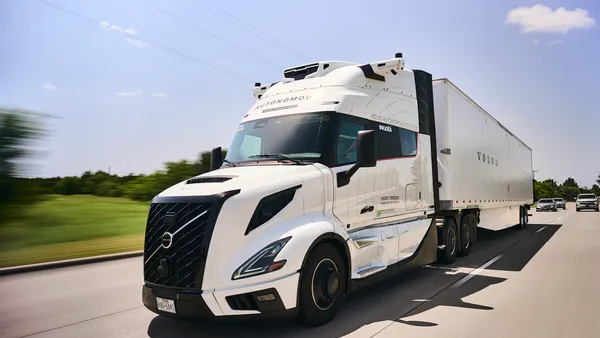
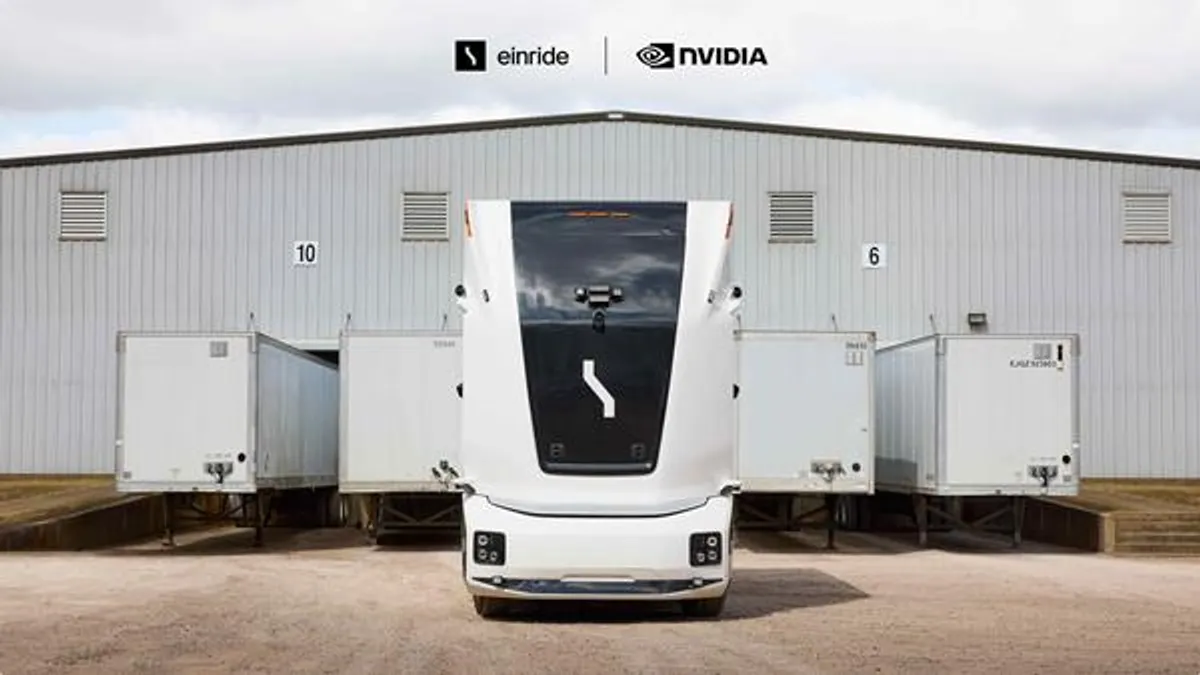
- Einride will build the next generation of its autonomous driving system on Nvidia’s Hyperion platform, according to a Sept. 21 press release.
- The Level 4-ready platform has mostly been used by automakers and robotaxi companies, including VinFast and Uber. Einride will work directly with Nvidia to extend the platform’s compute, sensor, software and safety architecture to the demands of heavy duty freight, per the release.
- Einride will continue to design, build and operate its autonomous driving system end to end, but the Sweden-headquartered company will now develop it using Nvidia’s hardware and AI tools, including the Halos safety system, Blackwell architecture, Exemplar Cloud and Cosmos, the press release said.
Dive Insight:
The partnership comes as Einride races to reach the scale it needs to break even.
The company plans to triple its fleet from 250 to 750 trucks by the end of 2027 through a recent partnership with Tesla.
But Einride needs an estimated fleet size of 1,500 to 2,000 trucks to be cash-flow neutral, a milestone it projects for 2028, according to its Aug. 18 earnings presentation.
CEO Roozbeh Charli pointed to the customer demand as the path there. During Einride’s Q2 earnings call, he said joint business plans with customers represent up to $800 million in potential annual recurring revenue, which “sets the basis for that growth,” adding the company’s sales pipeline has tripled.
Einride estimates about 80% of that demand could be automated in the medium term as its autonomous technology matures.
“We have the customers, the operational experience and the technology,” said Henrik Green, CTO at Einride, in the September release. “Building the next generation of the Einride Driver on the NVIDIA Hyperion platform, will enable us to scale autonomous deployment across a freight network that's already serving customers today.”
The Nvidia deal builds on Einride’s existing work with truck manufacturers.
Before this announcement, the company said it will integrate its autonomous drive system into the electric truck platform of Paccar-owned DAF. Initial interface testing was slated to begin in 2026, followed by integration, validation and functional testing in 2027.