Dive Brief:
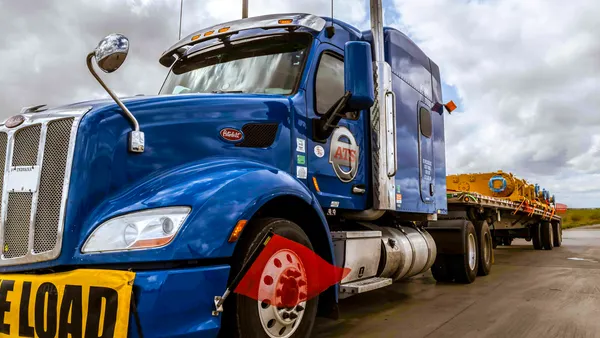
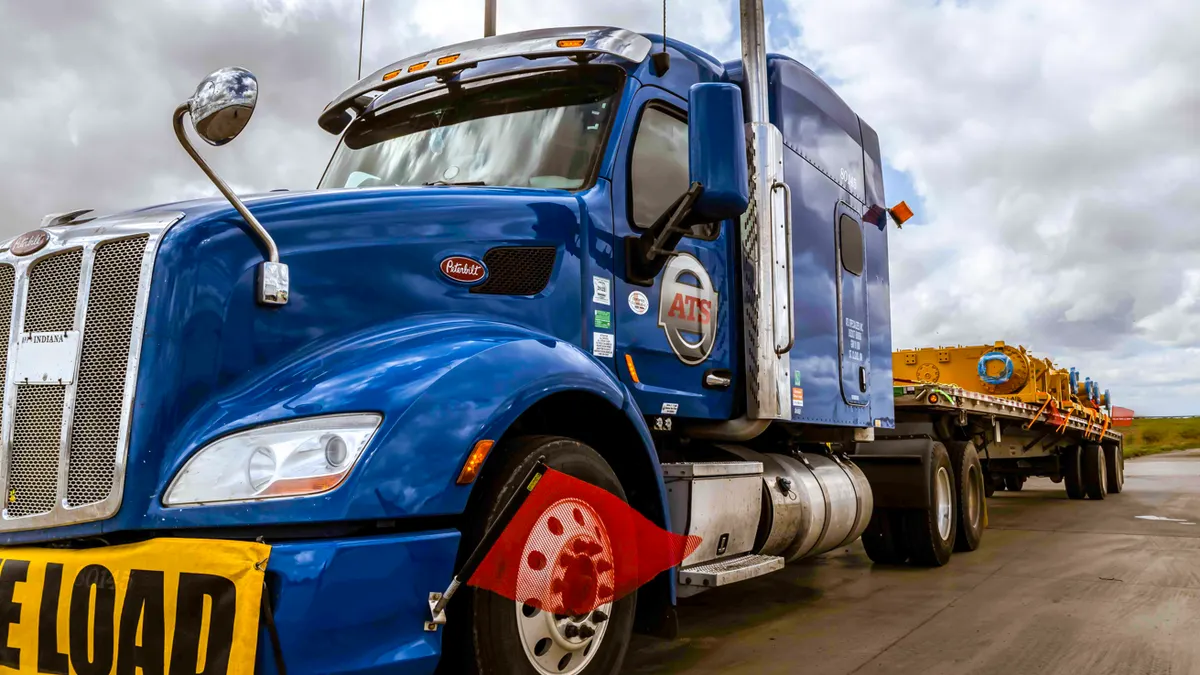
- Anderson Trucking Service has increased base pay for flatbed drivers 16.7%, from 60 cents a mile to 70 cents a mile, the company announced Sept. 22. The 10-cent increase, which also applies to all other experience levels, was effective Sept. 21, the company said in an email to Trucking Dive.
- The pay increase for flatbed drivers follows the St. Cloud, Minnesota-based carrier’s announcement earlier this month that it raised pay rates for dry van drivers by the same amount.
- “At ATS, we regularly review driver compensation to ensure it recognizes the value our drivers create while remaining competitive in a changing market,” Lori McNaughton, senior director of operations at Anderson Trucking Service, said in the release.
Dive Insight:
Anderson Trucking Service said its latest pay rate increase applies to its current team of 327 flatbed drivers. The 10-cent per mile increase applies across all classes and tenure levels and covers both loaded and empty miles, per the release.
This year, the carrier said its top 50% flatbed drivers averaged $1,600 per week, while the top 20% averaged $2,100 per week.
Anderson Trucking Service joins a recent string of pay increases announced by many carriers including Roehl Transport and Averitt. Nussbaum Transportation announced a pair of pay increases, one in May and another on Sept. 23.
Tightening driver capacity is fueling the recent wave of driver pay increases, Avery Vise, vice president of Trucking with FTR Transportation Intelligence, said in an email to Trucking Dive.
He said driver supply has been falling for nearly three years. Preliminary Bureau of Labor and Statistics data shows truck transportation and warehousing staff at its lowest August level since 2017.
Competition for drivers has intensified as federal regulators have cracked down on non-compliant commercial driver’s license schools, stepped up enforcement of English language proficiency and tightened access to non-domiciled CDLs.
Vise said the market rebound has been fueled through a combination of low capacity and modest freight improvement.
“That situation produced a surge in freight rates, which has prompted more aggressive recruiting by carriers seeking to capitalize on the stronger market with more volume and the ability to handle their customers’ freight rather than let it go elsewhere,” Vise said.
Executives with major carriers including, J.B. Hunt Transport Services and Schneider National, also noted during investor conferences earlier this month that they were also facing rising driver recruitment and retention costs.
Schneider National President and CEO Jim Filter said during an investor conference the company began exploring raising driver pay in Q2 as part of an effort to retain its most productive drivers but keyed in on specific opportunities where customers sought capacity and were willing to fund it.
In J.B. In Hunt's case, the carrier also recognized the need to implement driver sign-on bonuses and raise pay in preparation for peak season.